INTERNSHIP JOURNEY SUMMARIES
WEEK 1
Monday, 21 September 2026
On the first day of the internship, I was introduced to the workplace environment and given a tour of the office facilities. I also received a brief introduction to the organization, its working environment, and general workplace procedures. During the session, I had the opportunity to meet and get acquainted with colleagues from different roles and teams.
This orientation helped me understand the organizational structure, workplace culture, and the general responsibilities expected throughout my internship. It also provided an initial understanding of how different team members collaborate in carrying out their respective tasks. 
Tuesday, 22 September 2026
I attended the team's daily morning meeting, which is conducted regularly to provide updates on the previous day's activities and outline the tasks planned for the current day. This meeting helped me understand how the team communicates progress, coordinates tasks, and manages daily activities.
As I had not yet been assigned a major technical task, I used the available time to revise and practise Linux commands, particularly commands commonly used for system administration and cybersecurity-related activities.
I was also given an explanation by Encik Syafi regarding the main types of cybersecurity services provided by Kesatria Awan. These include:
Security Best Practices – implementing recommended security practices to improve an organization's overall security.
Security Monitoring – monitoring systems and network activities to identify suspicious activities, potential threats, or security incidents.
Penetration Testing (Pentest) – conducting authorized security testing to identify vulnerabilities that could potentially be exploited.
Security Posture Assessment (SPA) – assessing an organization's overall security posture, including its existing security controls, weaknesses, and areas that require improvement.
Later, I was provided with a laptop and was involved in setting up the operating system using Zorin OS Linux through balenaEtcher. This gave me practical exposure to preparing a Linux-based workstation for use in a technical environment.
Wednesday, 23 September 2026
As there were still no major assigned tasks, I continued revising Linux commands to strengthen my familiarity with the Linux environment.
I was then introduced to public key and private key authentication, particularly in relation to Secure Shell (SSH). I learned how SSH can be used to securely access a remote server without relying solely on password-based authentication.
I practised connecting to a server using commands such as:
ssh user@ip_address
and, when using a specific private key:
ssh -i ~/.ssh/ka-key user@ip_address
I also learned how to simplify SSH connections by configuring the SSH client configuration file using:
nano ~/.ssh/config
Through this configuration, parameters such as Host, HostName, and User can be defined. Once configured, the connection can be accessed using a shorter command such as:
ssh nik
This activity provided practical understanding of SSH-based remote administration, public-key authentication, private key management, and Linux configuration, which are important concepts in network and system security.
Thursday, 24 September 2026
I was introduced to the use of a password management solution as an alternative to storing passwords directly in a browser's password manager. I learned about Bitwarden and Vaultwarden, particularly their role in securely managing and storing credentials.
This activity provided exposure to the importance of proper credential management, including reducing the risks associated with storing passwords insecurely or reusing credentials across different services.
Later, I was assigned a new task to develop an internship portfolio website using WordPress and Divi Builder. The purpose of the website is to document and present my internship activities, projects, technical skills, and learning progress throughout the internship period.
I began familiarizing myself with the WordPress environment and the Divi Builder interface before starting the website development process.
Friday, 25 September 2026
I continued working on the internship portfolio website using WordPress and Divi Builder.
The main focus was on developing the website structure and arranging the content into appropriate sections. I explored the Divi Builder's page-building features and worked on designing the website layout to make it professional, organized, and suitable for documenting technical internship activities.
Through this task, I gained practical exposure to WordPress content management, website development, page layout design, and web-based portfolio development. It also allowed me to apply both technical and communication skills by presenting my internship work in a structured and professional manner.
WEEK 2
Monday, 28 September 2026
I continued developing my internship portfolio using WordPress and Divi Builder by organizing the content to be included, such as internship projects, relevant academic projects, technical skills, certifications, and contact information.
At the same time, I continued improving my Linux and cybersecurity skills through OverTheWire: Bandit, where I practised Linux commands and basic security-related problem-solving through hands-on exercises.
Tuesday, 29 September 2026
I continued making progress on the internship portfolio while simultaneously completing exercises on OverTheWire: Bandit to further strengthen my Linux and cybersecurity fundamentals.
After the break, Encik Fahmi introduced me to Docker and explained its purpose and practical applications. I learned that Docker is a containerization platform that allows applications and their dependencies to be packaged and run in isolated containers. Unlike a traditional virtual machine, containers generally share the host operating system's kernel, making them lightweight and efficient for deploying applications and services.
I was then introduced to several applications and services that could be deployed using Docker:
1. Immich – a self-hosted photo and video management platform, commonly used as a private alternative for managing personal media.
2. Pi-hole – a network-level DNS filtering solution that can block advertisements and known unwanted domains for devices connected to a network.
3. Portainer – a web-based management interface that simplifies the management and monitoring of Docker containers, images, networks, and volumes.
Through this activity, I gained initial practical exposure to containerization, Docker-based application deployment, self-hosted services, and container management. This was particularly useful for understanding how different services can be deployed and managed within a Linux environment.
Wednesday, 30 September 2026
Continued practising cybersecurity skills through OverTheWire: Bandit to strengthen Linux command-line knowledge and problem-solving abilities. Additionally, Encik Syafi invited me to access Kesatria Awan's Git repositories, including kawanpro-wifi-checker-mobile.git and kawanpro-wifi-checker-web.git, providing initial exposure to the organization's software development projects.
Thursday, 1 October 2026
Attended an agentic AI learning session conducted by Encik Fahmi and Nina, where I explored various AI tools, their capabilities, and applications. Learned important security precautions when using AI in the terminal, such as avoiding execution in the root directory. Subsequently, installed and configured Oh My Pi (OMP) as a terminal-based agentic AI tool to assist with setting up and configuring the Plane application.
Friday, 2 October 2026
Continued developing the internship portfolio using WordPress and Divi Builder by refining the website structure and content. Also completed the weekly internship logbook by documenting the activities, tasks, and technical knowledge gained throughout the week.
WEEK 3
Monday, 5 October 2026
Continued developing the internship portfolio using WordPress and Divi Builder, focusing on improving the website's content and layout.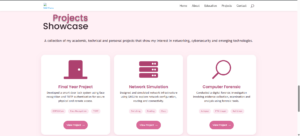
Tuesday, 6 October 2026
Continued working on the WordPress portfolio. After lunch, Encik Fahmi provided access to the Wi-Fi Checker mobile app code repository for further exploration and hands-on practice. Continued learning about agentic AI and its application in technical tasks.
Wednesday, 7 October 2026
Continued exploring and understanding the Wi-Fi Checker mobile app code. Successfully deployed the app, making it available to download and test through Expo Go. Also reviewed public and private key authentication to improve my understanding of the concept.
Thursday, 8 October 2026
Encik Fahmi provided further explanations to Nina and me regarding public and private key authentication, as we were still having difficulty understanding the concept. We applied the knowledge while exploring the mobile app repository. In the afternoon, attended the monthly meeting with the team to discuss updates and progress.
Friday, 9 October 2026
Attended a meeting regarding the e-Invigilator Support Program (EISP). Worked on correcting WordPress settings and creating a Google Form for EISP part-time recruitment. Encik Syafi also provided further explanations about Expo Go and its usage.